10 March 2026

5 February 2026

I would say that Maison Dourthe led me to the world of wine. I have lived with the company since birth, as my father spent much of his career there and has been a shareholder since 1998. After Sciences Po, a Master’s degree in International Affairs and a university diploma specialising in Asian Studies, I joined emlyon business school, which opened the prospect of a professional life oriented towards business.
My passion for Bordeaux and its wines, combined with the opportunity to move to Hong Kong within a rapidly growing market, ultimately convinced me to join the company in 2014, following a period at LVMH in marketing, notably working on Cloudy Bay.
Yes, a very precise moment comes to mind: I remember a conversation during my second year at Sciences Po with two friends. We were working in the vineyards of Château La Garde over the summer and, between rows of vines, discussing the opportunity of pursuing a dual degree at emlyon. That was a real turning point for me, as until then I was rather heading towards a career in NGOs or diplomacy. Encounters have also been decisive: meeting the Thiénot family, and particularly Stanislas, owner of the Arvitis group, but also Thomas Percillier, with whom I worked in Asia and who became a true commercial mentor to me.
My role primarily focuses on the company’s development, staying close to the markets while supporting commercial action and performance. My scope covers sales, marketing, communications and public relations, in close collaboration with Pénéloppe Godefroy, the new Managing Director of Maison Dourthe.
I do not remember the first time, as I was too young. However, every time I enter a winery cellar, the smell reminds me of La Garde — a familiar feeling undoubtedly linked to childhood memories. And what also strikes me is the attachment people develop to the place. Everyone who has worked there seems to keep a special bond with it. One grows attached to La Garde.
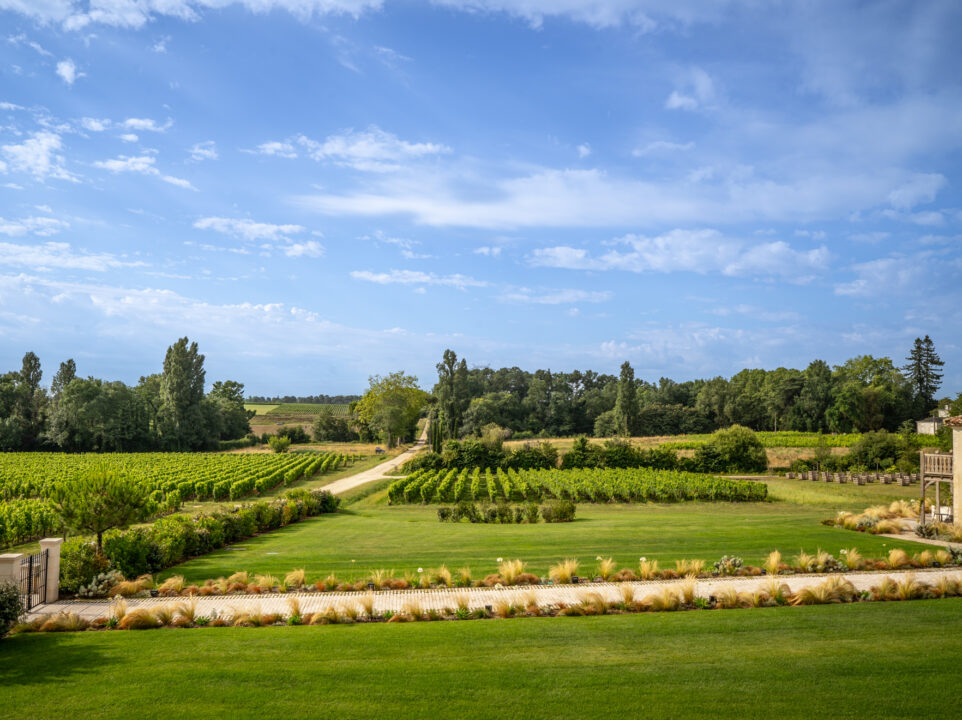
This abundant natural environment right on the doorstep of Bordeaux. It is a genuine haven of preserved nature at the end of a small communal road in Martillac. You need to go there to understand that something special happens there — a strong connection between people and nature. Our soil and biodiversity studies have confirmed this impression, revealing exceptional diversity.
The major “new” La Garde project launched in 2019, which, with the 2023 vintage, is now showing its first organoleptic proof points. It is a unique and ambitious project serving the expression of an exceptional place to which I am personally very attached.
2025 has been a rather good year. From a quality standpoint, we are very satisfied. However, yields are low, both for reds and whites. For an estate like La Garde, this represents a real economic challenge, all the more so in the context of climate change.
Maison Dourthe seeks to express, with precision and sincerity, the identity of each place through its wines. La Garde is the best illustration of this ambition.
We are now able to welcome both professional clients and the general public at a level that reflects the ambition we hold for the property. Each visit creates an ambassador, because, once again, it is a place people grow attached to. I would like people above all to remember the exceptional character of this cru. It is a truly distinctive and unique place, and the wines reveal this, both in white and red.
Maintaining direct contact with the markets, because this cru deserves to be explained and presented with time and care. Sales and production are not opposites; at Maison Dourthe they are the two legs of the same body, as they have always been. It is part of our DNA.
By staying as close as possible to both clients and consumers. We mainly sell our wines through distributors, but we must also remain attentive to final consumer expectations. What excites me, even in a complicated period, is that wine lovers remain very positive about our wines and initiatives. We must stay the course, listen carefully, and accept areas for improvement in order to move forward. The variability of Bordeaux vintages teaches us to question established practices and adapt our production methods. This mindset should not stop at bottling. Finally, we must also learn how to make our work better known. Bordeaux is a magnificent region thanks to both its diversity and its concentration of expertise.
Continuing, almost obsessively, to express this magical place through the wines — and ensuring this is recognised across the markets.
My daily priorities are to promote the estate’s vision and to carry the demanding work carried out in the vineyards and cellar into the markets. This involves maintaining regular contact with the La Garde teams, taking part in certain tastings, and staying informed and attentive to their realities so as to better convey and promote their work.